On Monday morning, a buyer sends an enquiry about a spare part. They need three pieces of information: the price, the available quantity and the expected delivery date. The salesperson reviews the enquiry and completes most of their work before lunch. But they cannot send the quote. The warehouse needs to confirm stock, technical support needs to check that the product is suitable, and the sales manager needs to approve a discount.
The next day, the quote still has not been sent. The customer does not know where it has stalled. They are already checking another supplier.
The salesperson completed their work quickly. Why is the customer still waiting?
The salesperson’s speed has done nothing to achieve the outcome that matters. The customer still does not have the information they expect when they need it.
Fast employees do not necessarily mean a fast sales process
We usually track sales performance through the number of quotes sent, calls made, deals closed and revenue generated. These are all important measures. But how often do we measure the time between receiving an enquiry and the customer actually receiving a quote?
Imagine a distributor of technical supplies. The salesperson knows the products and uses the sales system well. To complete a quote, however, they need information from colleagues. The warehouse checks stock availability, technical support checks product suitability, purchasing confirms the delivery date, and the sales manager approves special terms.
Everyone completes their task. Yet hours or days pass between individual steps.
The problem is therefore not how quickly employees work, but how work moves between them. When each department tracks only its own tasks, the business can lose sight of the total time from enquiry to quote. Customers cannot see the internal process, nor are they interested in it. They see only when they sent their enquiry and when they received a quote.
Preparing a quote is not finished when the salesperson completes their work. It is finished when the quote reaches the customer.
What matters to buyers is when they receive the information they need to make a decision. If they have to wait two days without knowing when to expect an answer, the supplier can seem unreliable. In the meantime, they may be gathering other quotes or adjusting their plans. An internal delay therefore affects the sales experience and the chances of winning the order.
Why can 70 minutes of work mean 29 hours to deliver a quote?
When preparing a quote, we need to distinguish between two measures:
- Active working time: how much time employees actually spend checking information, agreeing terms and preparing the document.
- Quote lead time: how much time passes between receiving the enquiry and sending the quote.
A business receives an enquiry on Wednesday at 8:30 am. The salesperson prepares a draft, the warehouse checks stock, technical support confirms product suitability, and the manager approves the terms. Together, these tasks require 70 minutes of active work. Yet the quote is not sent until Thursday at 1:30 pm.
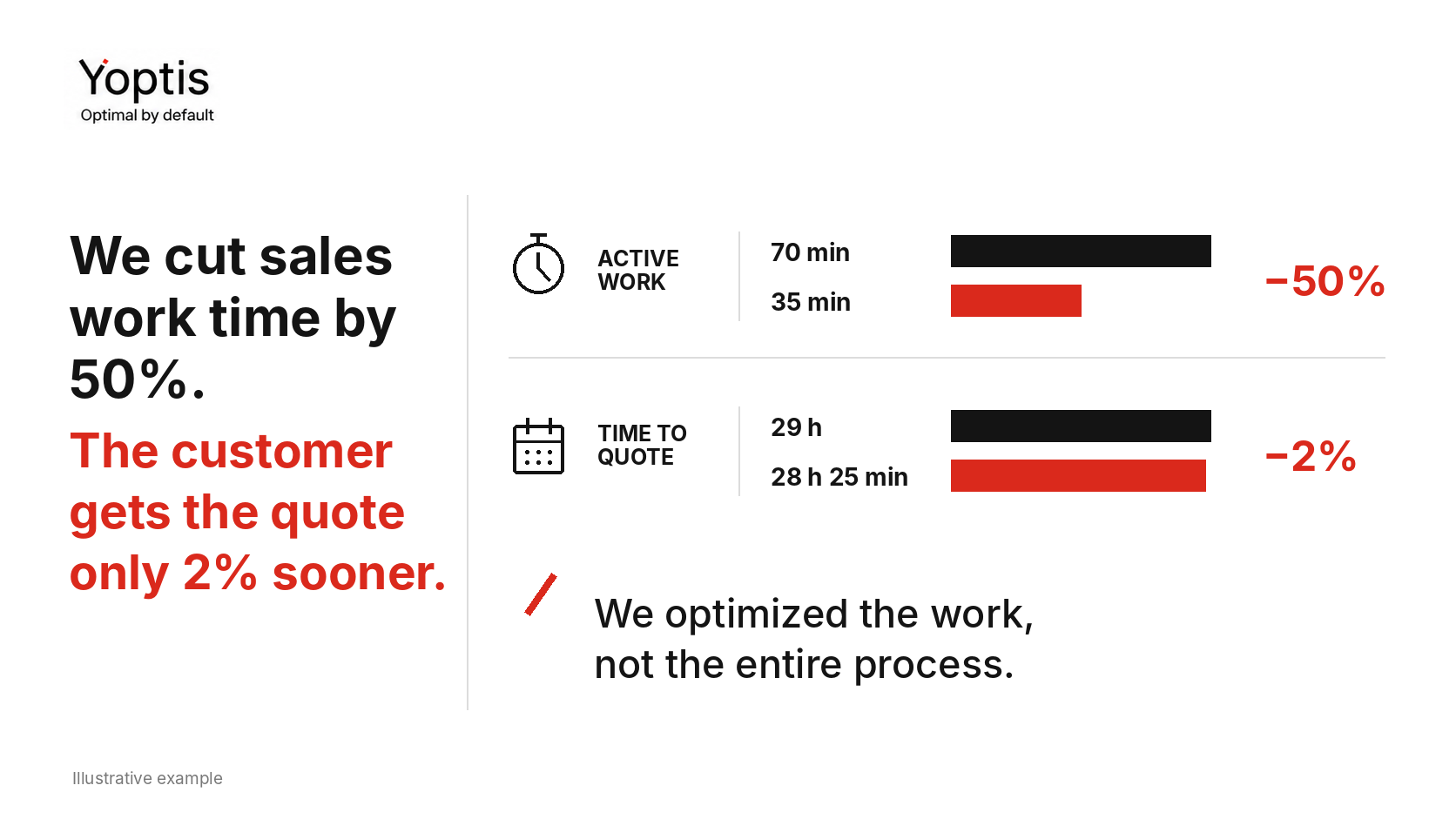
In this example, reducing the time spent preparing the document will not produce a substantially faster response. If the quote still waits days for approval, the customer will not even notice a saving of a few minutes.
Before introducing automation, buying a new system or expanding the sales team, it is therefore useful to understand what happens during the rest of that time.
Where can sales quote preparation get stuck?
For technical products, a quote is not always just a document with a price. It may involve checking availability, specifications, compatibility, delivery terms and special agreements. Many of these steps are justified. The question is whether they happen on time and without unnecessary rework.
Checking stock and delivery dates
The salesperson can see stock in the system but does not know whether it has already been reserved for another customer. They have to ask the warehouse or purchasing team for confirmation. If the information is not sufficiently up to date, or it is unclear who confirms it, the quote can sit waiting for information that should already be available during preparation.
More complex orders may need additional checks. Controls are necessary, but it is important to recognise when they add value and when they cause unnecessary delays.
Technical questions and missing specifications
A customer enquires about a component, but it is unclear which version suits their application. The salesperson forwards the question to technical support. The support team needs more information, so the enquiry goes back to the salesperson, then to the customer, and back to technical support again.
If the same clarifications keep coming up, it makes sense to check which information could be collected at the first point of contact.
Approving prices and sales terms
Special discounts, extended payment terms and higher-risk deals may rightly require approval. That is why standard quotes need to be distinguished from more complex deals.
Clearly defined authority and limits can allow the sales team to make decisions independently in routine cases while retaining the necessary oversight for more complex ones. Giving the sales team some autonomy can significantly improve their efficiency.
Handovers between departments
The quote is ready but is waiting for a colleague’s response. That colleague does not know the task is ready for them to handle. Meanwhile, the salesperson does not know whether the colleague has picked it up.
When information moves between email, spreadsheets, an ERP system and phone conversations, work can stop even without any information being lost. All it takes is uncertainty about who is responsible for the next step and when they need to complete it.
How can you measure why quote preparation takes too long?
You do not need new software for an initial review. Start with existing records, emails and comparable completed quotes.
For example, select 15 to 20 recent enquiries of the same type. This is a useful initial sample for identifying recurring issues.
For each case, record:
- Receipt and sending: when did the enquiry arrive, and when was the quote sent?
- Handovers: how many employees or departments handled the case, and how long did it wait to be picked up?
- Requests for further information: how many times was it sent back because information was missing or unsuitable?
- Reasons for delay: was it waiting for an internal decision, a supplier or additional information from the customer?
- Quote type: was it a standard order or a complex technical enquiry?
Distinguish working hours from calendar hours, and internal waiting from time spent waiting for a customer or supplier. Compare similar cases; otherwise, one particularly complex deal can distort the average.
Start by tracking three measures: quote lead time (ideally the median and slower cases), the proportion of quotes returned for further information, and waiting time at key handovers.
What might a review of 20 quotes reveal?
Suppose your review produces results like these:
| KPI | Result |
|---|---|
| Quotes reviewed | 20 |
| Quotes requiring stock confirmation | 12 |
| Quotes returned for further information | 6 |
| Median time from enquiry to quote | 18 hours |
The data suggests where to look more closely. The fact that 12 quotes require stock confirmation does not, on its own, prove that stock checks are the biggest bottleneck. It does, however, identify a frequent point to investigate.
If standard quotes regularly spend several hours waiting for one approval, that is a much more useful finding than a general impression that “sales works too slowly”.
How can you speed up sales quote preparation?
The right action depends on the cause. In practice, the first step is often simpler than it seems:
- Fewer requests for missing information: for recurring enquiry types, define which technical details the salesperson needs to collect at the start.
- Clearer approvals: specify which standard quotes the team can approve independently and when additional approval is required.
- More visible handovers: assign responsibility for the next step and make it clear whether the task has been picked up.
Where should you start improving the sales process?
An initial review will probably reveal several opportunities: unclear information, duplicate records, additional approvals and waiting between departments. If you try to change everything at once, it will be difficult to establish what actually improved the result. You may also give up during implementation.
Start by choosing one recurring constraint that has a meaningful effect on the time to quote and can be safely tested.
Suppose standard quotes wait for manual confirmation of stock availability, even though the data for a particular product group is generally reliable. The business can investigate whether this additional confirmation could be removed for those products.
Before making the change, it needs to check data accuracy and the risk of making incorrect promises to customers. It can then compare lead times before and after the trial while monitoring errors in stock and delivery commitments. If responsiveness improves without a drop in quality, it has evidence for the next decision.
This is the essence of business process optimisation: changing a process based on actual workflow, evidence and verifiable effects, rather than simply because something feels slow.
Customers cannot see your internal steps. They do notice when they receive the answer they need to make a decision.
Your sales team may not need more time. It may need less waiting.
If quote preparation takes longer than you would expect, hiring more employees or introducing a new information system should not be the first response. First, establish where enquiries get stuck.
With Yoptis Flow Check, we focus on one clearly defined business process. We review key handovers, waiting times and rework, then develop a testable hypothesis for improvement.
The result is a written Flow Report to help you decide on the next step. Implementing improvements is subject to a separate agreement. It is a short review that can help speed up your work without additional hiring or major investment.
Do not start with a new solution. Start by understanding the problem.